Evidence in context
Tirzepatide evidence: which comparison could test a support claim?
A study-reading guide to causal contrasts, observed exposure and outcomes that require their own measurements.
Before treating a favorable result as evidence for support, specify the support being offered and the outcome it is meant to change. This guide works backward from that proposed claim to the comparison capable of testing it. The chart is a reading exercise; the invented designs and numbers are explicitly hypothetical.
The aim is to separate a useful description from a causal answer, then identify what evidence would close the gap between them.
Specify the contrast before the result
The question determines which comparison is informative.
Imagine two hypothetical offers: a scheduled conversation with a defined support team, or access to a specified information resource without that conversation. For each imaginary person, there is an outcome under the first offer and an outcome under the second. Only one can be observed for that person in the same comparison period. The causal question concerns the contrast between those possibilities, not simply the outcome that happened to be recorded.
In this thought experiment, people who seek the conversation themselves might differ from those who choose the resource. Suppose, hypothetically, that urgency influences both their choice and their eventual functioning. A difference between users would then combine the proposed intervention contrast with a difference in who entered each group. This imaginary mechanism is not a claim about actual service users. It explains why describing the participants cannot substitute for specifying how the comparison was formed.
A hypothetical randomized offer would change that part of the design by assigning the offer rather than using self-selection to define it. It would still need a clear outcome, follow-up plan and account of whether the offered service was used. State the target contrast in a sentence before looking at any favorable result. Otherwise, the question can quietly move from the effect of offering a particular service to the experiences of people who happened to use it.
Read the estimate as an estimate
Begin with the figure's full caption and ask what kind of quantity the bars display. Keep the named population, endpoint, grouping rule and observation limits attached to the values. Then separate a description of a group from a forecast for a person. A statement about a summary does not, through repetition, become an individual prediction. To propose a prediction, you would need to define the person, the information available beforehand and how prediction error would be assessed.
Consider a hypothetical pair of groups whose estimated average outcomes appear close on a chart. That visual impression leaves several questions unanswered. What difference would count as meaningfully different? How uncertain are the estimates? What process created the groups? In this imaginary example, drawing equally long bars would not supply the missing definitions or uncertainty. Exact equality of displayed rounded values would be a statement about those displayed values, not a proof that the underlying outcomes are equivalent.
Ask separately whether the hypothetical groups represent interventions that could be compared causally. If group membership was defined by something observed after the comparison began, the label alone would not tell you what would happen if that feature were changed. Do not add unseen error bars, interpret proximity as a successful equivalence test, or choose a personal expected result by locating yourself beside a group label.
Read the estimate as an estimate
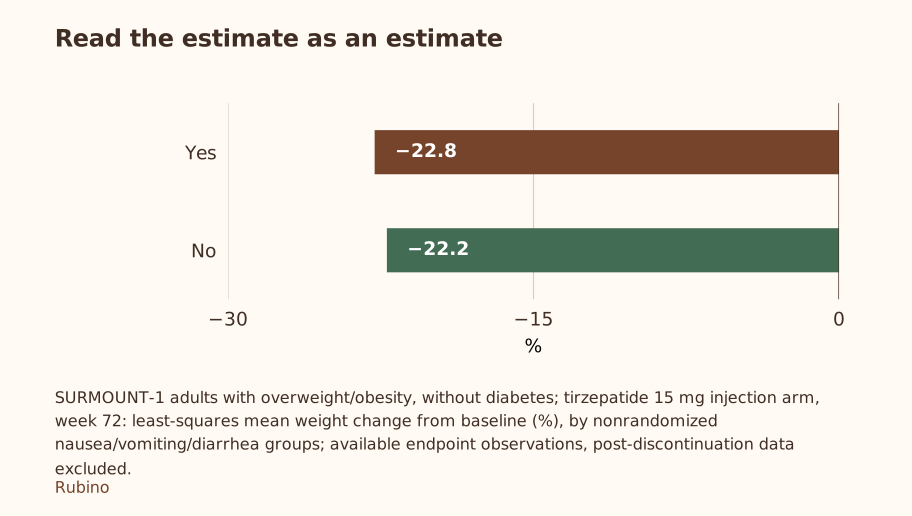
| Reported | % change |
|---|---|
| Yes | −22.8 |
| No | −22.2 |
A membership rule is not an assignment
One reported nausea, vomiting or diarrhea event qualified participants for the corresponding subgroup.[1]
Distinguish the rule that places a record in a group from the procedure that assigns an intervention. As a hypothetical example, imagine assigning people to two information formats and later grouping them by whether they asked a question. Assignment to a format happens before the response; membership in the question-asking group is learned afterward. Those groupings describe different comparisons, even though they involve the same imaginary participants. Reusing the participants does not transfer the assignment procedure to the later grouping.
In this fictional example, prior familiarity might influence both question-asking and the eventual task score. A simple comparison of people who did and did not ask questions could then reflect that hypothetical common influence. It would not isolate the effect of asking a question. The example does not allege an actual imbalance in the medication analysis. Its purpose is to show what an assignment procedure would need to protect and what a membership label cannot guarantee by itself.
Ask whether it distinguishes occurrence, repetition, timing or intensity, and resist adding distinctions it does not contain. For the hypothetical question-asking group, an “ever asked” rule could combine very different sequences of behavior. Recovering those sequences would require their records. A broad category can be appropriate for a broad descriptive question while remaining insufficient for a more specific causal question. The limit follows from the question and rule together.
Choose an outcome that answers the question
Different outcomes require their own observations.
Create a hypothetical support study with two separate outcomes: attendance at an offered session and functioning during a defined later period. Attendance could be recorded from a session log. For the imaginary functioning outcome, specify an assessment of completion of activities selected before assignment. Neither the log nor the assessment becomes the other merely because both appear in the same spreadsheet. The study's proposed benefit must determine which outcome is central to the claim.
Suppose, hypothetically, that every attendance entry is complete but several functioning assessments are absent. The complete log would answer the attendance question without filling those missing assessments. Assuming that attendance means improved functioning would insert the very relationship the study was meant to investigate. In this made-up study, one could report attendance accurately while leaving the functioning claim unresolved. Presenting both outcomes with their own missingness would make that distinction visible to a reader.
Before interpreting either result in the hypothetical design, set the assessment timing, direction of improvement and comparison period. Also ask whether the activities selected by different people support the intended shared interpretation. Use the compound profile to keep the subject of a medication question distinct from the outcome of a proposed support study. Each claim needs observations of what it actually names.
State what happens after exposure changes
Analyses used available endpoint observations and excluded data after treatment discontinuation; symptom groups were not randomized.[1]
Imagine a support study in which some people stop using the offered program. One hypothetical question asks what happens after the original offer, including what follows stopping. Another asks what would happen under continued use throughout the planned period. These are different targets, sometimes called estimands: each specifies the effect the analysis is trying to estimate. The wording must resolve what happens after use changes rather than leaving that choice to whichever observations are easiest to obtain.
For the hypothetical offer question, continue seeking the selected outcome after a person stops using the program. Otherwise, the answer would omit part of the policy being evaluated. For the hypothetical continuous-use question, outcomes among those who continue are relevant but do not automatically represent what everyone would experience under continued use. Reasons for stopping might also relate to outcomes. That possible selection would require an explicit argument and information; deleting the stopped records would not settle it.
Draw a timeline for the fictional study, marking assignment, each change in use and each planned observation. Place the target question above it. You can then see which observations are needed and where assumptions would replace them. A missing observation and a decision to exclude an observed value should have different explanations. Neither target is automatically preferable for every purpose.
Separate a package from its components
All trials included lifestyle counselling; symptom management could include dietary changes, medicines, interruption or dose reduction.[1]
Consider a wholly hypothetical experiment with components A and B and an invented score in arbitrary units. Suppose the score is 4 with neither component, 7 with A alone, 6 with B alone and 12 with both. These stipulated values are not weight-loss, psychotherapy or medication estimates. In this fictional arrangement, the contrast for adding B without A is 6 minus 4, or 2; adding B with A gives 12 minus 7, or 5.
The hypothetical contrasts differ because the effect assigned to B in this constructed example depends on whether A is present. That is the interaction the exercise was designed to illustrate. Even an observed package benefit would require an appropriate component comparison before assigning it to a particular ingredient. The arithmetic alone supplies neither evidence that these invented scores would occur nor a rationale for choosing a real service.
Use the example to formulate a reading question: were the components separately varied in a way that answers the claim being made? Keep that question when visiting the existing comparison guide, without treating different medication summaries as a factorial experiment. A package description can help identify what was offered. Establishing the contribution of one component requires a comparison that isolates the relevant change while explaining what else is held fixed.
Observation can change independently
Changing observation is not automatically changing the observed experience.
Imagine an automated check-in that changes how an imaginary participant reports an experience. There are two hypothetical paths to examine. The check-in might affect the experience itself, or it might affect whether an unchanged experience is described. Both paths could produce a difference in recorded reports. A count of those reports alone would not identify which hypothetical path operated. The example gives no evidence that any actual automated tool detects problems or improves wellbeing.
Make the fictional comparison more precise by separating the reporting opportunity from the outcome assessment. Suppose the imagined check-in supplies extra prompts, while both groups receive the same independent functioning assessment at the same planned time. That arrangement would allow separate questions about reporting and functioning. It would not guarantee either benefit. If the check-in also changed how functioning was assessed, the interpretation would need to account for that change instead of attributing the whole difference to a better experience.
In the companion analysis, approach the reporting exercise with this distinction in mind. Ask whether the observation process is part of the proposed intervention, part of its measurement, or both. In the fictional check-in study, recording when a prompt appeared and what followed it could help investigate the observation pathway. The intended causal claim would still need an outcome and comparison capable of separating that pathway from a change in the experience the program promises to improve.
Ask what uncertainty would change
Mediation was exploratory, unadjusted for potential post-randomization confounders and uncorrected for multiplicity.[1]
For a hypothetical mediation claim, imagine that an assigned support offer changes an intermediate behavior, which is then proposed to change functioning. Suppose an unmeasured event after assignment could influence both that behavior and functioning. Randomizing the offer would not, by itself, randomize the intermediate behavior or remove this hypothetical common influence. Drawing a chain from offer to behavior to outcome is a proposed explanation; estimating each part causally needs assumptions suited to those relationships.
Now consider two invented uncertainty intervals for a separate imaginary score difference: from minus one to seven, and from two to four. Both hypothetical intervals have a center of three. Their widths convey different levels of precision under the stipulated exercise, despite that common center. These are not intervals from the paper, and no confidence level or calculation is being attributed to them. If a decision depended on the direction of the difference, the hypothetical intervals would leave different possibilities open.
Before asking for a narrower interval, ask whether it would address the relevant uncertainty. Greater numerical precision would not repair a wrong comparison or an outcome that misses the claim. In the hypothetical mediation example, an extremely precise association could still leave the causal pathway unresolved. Identify the assumption whose failure could change your conclusion, then specify the observation or design that could challenge it. This makes uncertainty a concrete research question rather than a generic phrase added after an attractive estimate.
Identify the assumptions behind transfer
Imagine moving a support intervention from a staffed setting to an automated one. Start by describing what would actually be carried over: the content, timing, opportunity to ask for clarification and definition of the intended outcome. If those features changed, the proposed intervention might no longer be the same intervention under a new label. This hypothetical transfer requires an argument about which features matter, not merely recognition that both settings use the word “support.”
Next specify an imaginary mechanism that could connect the offering to the outcome. Perhaps timely clarification is the hypothesized link. Ask whether the new setting supplies that feature in the relevant circumstances and how its presence could be observed. This is a testable proposal, not an established mechanism or an efficacy claim about a tool. A similar-looking interface would not, by itself, answer the mechanism question; neither would an unrelated favorable result from a different intervention.
Finally, consider the people and circumstances to which the hypothetical result would be applied. State which differences you assume irrelevant, which might modify the effect and what evidence could distinguish those possibilities. Transport becomes clearer when those assumptions are written down rather than hidden in a broad promise. You could then design a comparison in the intended setting or examine the specific link most in doubt. Until that work is done, the proposed transfer remains a research question without an individual forecast or vendor endorsement.
Describe evidence that could test the claim
An unresolved claim remains a question to test.
Write a falsifiable hypothetical claim: offering a specified conversation program improves a defined functioning outcome relative to a specified information resource over a predetermined follow-up period. Explain which observations would count against that claim, including a result too uncertain to distinguish the possibilities of interest. A claim that treats every possible result as success cannot be evaluated by this comparison. Define the important difference before seeing the results so that the criterion does not move with them.
For this fictional study, retain assignment information, changes in participation, planned outcome assessments and reasons for missing observations when known. Make the proposed comparison reproducible and examine assumptions that could alter its interpretation. Use the source register and the public funding note to ask who shaped the question and which analytic decisions can be checked. A disclosure supplies context for scrutiny; it does not mathematically determine the sign or credibility of an estimate.
The absence of a relevant comparison should leave the hypothetical support claim unresolved. It should not be relabeled proof that support cannot help, nor converted into a favorable claim by borrowing a medication result. The productive next step is to identify the smallest decisive gap: intervention definition, outcome measurement, comparison formation or follow-up. Evidence addressing that gap could strengthen or weaken the claim. A clear unanswered question is more informative than a confident answer to a different question.
How to weigh the evidence
A support claim becomes testable when its intervention, alternative, outcome and follow-up are specified together. The hypothetical examples show how a persuasive description can leave that causal target unresolved: membership may replace assignment, complete attendance may conceal missing outcomes, and a package may obscure its components. A defined comparison in the intended setting could challenge the claim; clearer observation could reveal whether the measured change concerns reporting or experience. Those possibilities leave room for benefit, no meaningful benefit or unresolved uncertainty. The appropriate judgment depends on the comparison actually made and the assumptions it needs, not on how confidently a result is extended to another service.
Questions and answers
Can a medication result demonstrate a support benefit?
A proposed support benefit needs a comparison that varies the defined support and measures the relevant outcome. A different favorable endpoint cannot supply that missing contrast. In the hypothetical designs here, the intervention, observation process and outcome are separate choices. Leaving the support question unresolved is different from concluding that the offering has no effect.
Why does continued exposure change the research question?
In the hypothetical study, following the original offer includes what happens after use changes. Asking what would happen under continued use targets a different scenario and requires assumptions about it. Observations from people who continue do not automatically answer what everyone would experience. Naming the target clarifies which follow-up is needed and which missing information remains important.
What does the absence of a relevant outcome tell us?
If a proposed outcome was not observed, an unrelated result does not reconstruct it. That is a limit on the inference, not proof of an absent benefit. The hypothetical attendance example makes the distinction concrete: a complete session log cannot supply missing functioning assessments. Ask about the particular analysis and outcome rather than making a blanket statement about all trials.
Scope of this analysis
The invented designs, scores and intervals illustrate reasoning only. They do not estimate medication, psychotherapy or automated-support effects. The guide does not determine an individual outcome or identify a preferred service. Its conclusions concern what a comparison would need to answer, with empirical claims confined to the cited study passages and figure.
Prepared with AI assistance. Medical review is pending.
Funding and authorship context
Eli Lilly funded the study; six authors were employees and shareholders, and a Lilly writer contributed.[1]
Sources
Each date identifies a source check. It is separate from this page’s publication date.
- Rubino — Wiley; checked