Evidence in context
Semaglutide evidence: what does an adverse-event label measure?
How questioning, classification and follow-up shape what a safety record can tell us.
A safety summary becomes useful when you can connect its labels to the question you want answered. This guide follows that connection from an experience to a report, a classification and a conclusion. The figure provides a concrete place to practice; the fictional exercises make the inferential choices visible without pretending to reproduce participant data.
Keep two questions beside your notes: what information survived the measurement process, and what further information would the proposed conclusion require?
Start with the construct
This post hoc analysis pooled STEP 1–3; STEP 4 was analyzed separately.[1]
Imagine a hypothetical headline claiming that few recorded complaints mean little distress. Before accepting it, write down what each half refers to. A complaint is an entry in a record; distress is the experience the headline asks you to infer. The claim therefore needs a bridge between an observable entry and a personal experience. Counting the entries accurately would establish only part of that bridge. You would still need to explain why their absence answers the distress question.
For this hypothetical headline, separate experience, observation and purpose. Experience is what the person felt. Observation is what the questioning and recording process captured. Purpose is the decision you want the information to inform, such as whether someone could continue an activity they valued. A definition useful for one purpose might leave another unresolved. Asking which purpose a summary serves is more productive than treating every precise number as a complete description.
Read the study description alongside that distinction. Before combining records, ask whether the same question, observation window and classification rule would make their meanings comparable. Pooling is a calculation; compatibility is an argument that must accompany it. In the hypothetical headline, a larger collection of complaint records would not, by itself, supply the missing definition of distress. A sharper claim would name the recorded outcome first and make any proposed connection to distress explicit.
How an experience becomes a record
Event reporting used open-ended, non-leading verbal questions and subsequent follow-up.[1]
Consider a fictional exercise involving thirty people and a made-up reporting task. Fifteen volunteer a description without a specific prompt. A neutral follow-up prompt produces descriptions from ten additional people. Suppose, for this thought experiment only, that nobody's underlying experience changes between the two questions. The fictional record now contains twenty-five people with reports instead of fifteen, although the stipulated experience has stayed fixed. These invented counts illustrate a measurement problem; they estimate no actual underreporting.
The hypothetical difference concerns how an answer enters the record. It cannot establish that the second question captured every experience, that the first answer was dishonest, or that the added reports were unimportant. Those are separate possibilities requiring separate evidence. A prompt could invite a description without supplying the desired answer. Its usefulness would depend on what it asks and how answers are checked.
When reading a real methods section, follow the sequence from invitation to response to clarification. Ask whether an unanswered question differs from an explicit negative answer, and whether the record preserves that distinction. For the fictional exercise, retaining both response stages would let a reader reconstruct the increased reporting. Retaining only the final total would conceal its origin. The appropriate conclusion is about this hypothetical observation process, not the prevalence or seriousness of anybody's symptoms.
A code preserves some information
A consistent label can still leave a question unanswered.
Imagine two invented accounts of discomfort. One person writes, “It interrupted a conversation, then passed.” Another writes, “It kept returning while I tried to work.” For this exercise, invent a broad code called “discomfort mentioned” and assign both accounts to it. The shared code captures a common feature by construction. It does not preserve the contrast between a single interruption and repeated interference. This fictional code is not a definition used by the paper.
Now give the fictional accounts and codebook to two readers. Suppose both apply the broad code consistently. Their agreement would show that they can reproduce that assignment under the exercise's rule. It would not restore the details that the rule deliberately discards. Agreement and fitness for a question therefore need separate checks. If your question concerns disruption across a working period, you would need a way to retain or recover the relevant descriptions.
Try reversing the exercise: begin with the proposed conclusion and identify which raw distinctions it requires. Then inspect the fictional codebook for those distinctions. A broad tally might answer whether a description was recorded, while leaving its pattern unresolved. Adding a second field could preserve that pattern, but only if its meaning and recording rule were defined. The useful test is whether another reader could trace the conclusion back to information that actually survived classification.
Read two classifications together
Read the figure's caption before interpreting either bar. Ask what was classified, what the denominator represents and whether the labels divide that denominator into exclusive groups. Keep the displayed values beside their full context. A useful reading exercise is to say what calculation you would need before performing it. If a proposed total requires mutually exclusive categories, first establish that requirement rather than letting the shape of the chart imply it.
Imagine a hypothetical box of cards. Each card has a color and a pattern: blue or orange, striped or plain. A blue card can also be striped. Counting blue cards and counting striped cards answers different questions about the same box. Adding those counts would count some fictional cards twice. Even knowing both separate totals would not reveal exactly how many cards were simultaneously blue and striped; that needs their joint classification.
The hypothetical card exercise also separates labels from objects. If several cards came from one imaginary person, a card count would not reveal how many different people supplied them without a matching record. This is a logical reason to check the unit before changing the wording of a result. For the figure, use its stated unit and classifications. Do not invent a joint table, sum bars into a total, or turn a classified object into a person through arithmetic alone.
Read two classifications together
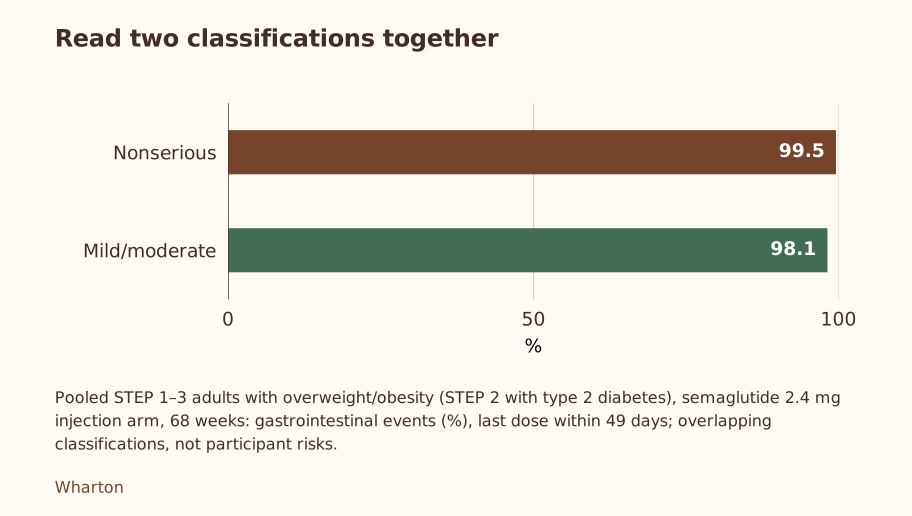
| Classification | % |
|---|---|
| Nonserious | 99.5 |
| Mild/moderate | 98.1 |
Choose the resolution before averaging
Take two hypothetical sets of scores: 0, 0, 4, 4 and 2, 2, 2, 2. Each fictional set adds to eight and has a mean of two. Yet the individual values differ: the first hypothetical set is divided between its extremes, while the second has identical entries. The common mean cannot tell you which arrangement produced it. These made-up vectors are an arithmetic exercise, not a reconstruction of trial responses or any clinical rating scale.
Now choose a question for the hypothetical scores. If the task is to report their average, either set gives the same answer. If the task is to identify entries above a threshold of three, the fictional sets give different answers. That threshold is invented for the exercise and has no clinical meaning. The required resolution follows from the question: an average cannot answer a threshold question after the individual values have been discarded.
A further hypothetical change makes the issue temporal. Let each vector describe consecutive observations of one imaginary person instead of separate people. Without knowing what the positions represent, the same notation invites incompatible interpretations. Before averaging, name the object, the observation period and the distinction you want to preserve. The calculation can then be evaluated for that purpose rather than admired for its apparent simplicity.
Missing observation leaves a different question
Build a fictional tracking sheet with two indicators: whether an imaginary participant continues an assigned activity and whether their outcome is observed. Keep the indicators separate. Someone could stop the activity while still supplying an observation, or continue it while missing an assessment. In this hypothetical system, neither indicator logically determines the other. Treating every stopped activity as a missing measurement, or every continued activity as a complete record, would erase possibilities the sheet was designed to distinguish.
Now imagine three different reasons for a blank outcome in that fictional sheet. An unrelated scheduling accident might prevent contact. A recorded timetable constraint might predict who misses contact. Or the unrecorded experience itself might affect willingness to respond. These are hypothetical mechanisms, not explanations assigned to trial participants. They imply different assumptions about what the observed entries can represent. The blank cell alone cannot choose between them, and a completed spreadsheet created by filling blanks would not supply the missing evidence.
For the fictional exercise, preserve the reason for each blank when known and state what remains unknown. Consider how your conclusion changes under different plausible values for the unseen outcomes, without pretending those values were observed. You can take the same distinction to the companion analysis: identify the target question before deciding which observations belong in its answer. That reading task keeps continuation, observation and inference separate without requiring a guess about any individual's reason for leaving.
Match the measure to the claim
A claim needs a measure of the thing it claims.
Suppose an invented service claims to improve emotional functioning but presents only a tally of physical complaints. Even if that fictional tally were counted perfectly, the proposed conclusion would still need an argument connecting it to functioning. A favorable direction in one measure cannot define a favorable direction in another. The service might have a testable idea, but the outcome named in its claim must become observable rather than remaining an attractive phrase.
Design a hypothetical functioning measure for the exercise. Define it as the number of personally selected activities an imaginary participant can complete during a specified observation period. State that, within this invented definition, higher values represent more completion. Record the selected activities before the comparison and use the same assessment timing for both groups. This is an illustration of operational definition, not a validated questionnaire or a recommendation for assessing a real person's mental health.
The hypothetical measure would still need scrutiny. Changed priorities could alter what completion means, and identical counts could conceal different activities. Those possibilities suggest questions about interpretation rather than excuses to substitute the physical tally. While consulting the compound profile, keep a separate note of the outcome your own question requires. The role of that note is to prevent an unnoticed switch from a question about a compound to a conclusion about a different kind of experience.
Test the measurement process itself
Imagine a hypothetical measurement experiment in which people read the same fictional vignette but receive different neutral requests to describe it. One wording asks what happened; another asks which parts interrupted the character's activities. Randomly assign the wording while keeping the vignette fixed. In this constructed task, the target material is identical by design. Differences in the descriptions would therefore invite examination of the question, the response process and the scoring rule before a claim that the vignette itself changed.
The hypothetical experiment would need a clear comparison. Specify what counts as a reported detail before reading the responses, preserve the original descriptions and consider whether scorers know which wording produced them. If the task also changed the scoring rule, a difference could no longer be attributed to wording alone. Holding one element fixed has value only when the other elements are recorded carefully enough to show what was actually varied.
Even a well-executed version of this imaginary exercise would answer a limited question. Sensitivity to wording would not automatically identify the more accurate wording, because agreement with an independent account would require another comparison. It also would not demonstrate a benefit from collecting more reports. A useful follow-up would ask whether the extra descriptions contain information needed for the intended decision. That question connects measurement sensitivity to purpose without turning an increased count into an improved experience.
Make the inference auditable
Trace a fictional response through a miniature analysis: “The interruption returned while I worked.” Preserve that raw sentence, apply the exercise's “discomfort mentioned” code, and place the entry in the appropriate tally. Another reader can check the transcription, reproduce the coding rule and recalculate the tally. None of those successful checks, by themselves, establish how distressing the interruption was. Reproducibility identifies a calculation or classification that can be repeated; it does not expand the meaning of the input.
For this fictional audit, write each inferential step as a separate sentence. The first says what was recorded. The next says how it was grouped. The last states what the grouping is proposed to show. Look for the first sentence that introduces something absent from the retained information. That is where a new assumption or observation is required.
Use the source register and the funding note as prompts for equally specific scrutiny. Ask which decisions can be checked, whether alternative definitions would answer a different question and what additional material would permit an independent reconstruction. A disclosed interest is a reason to examine those decisions, not a calculation that proves their direction. Conversely, a transparent disclosure cannot replace checking them. The strongest audit keeps provenance, reproducibility and the validity of the final inference as related but separate judgments.
Support needs its own evidence
A different intervention needs a different causal comparison.
Participants received lifestyle intervention; STEP 3 included intensive behavioral therapy for weight management.[1]
Turn a hypothetical support claim into a comparison: access to a defined conversation program versus an otherwise specified alternative, with an outcome chosen to represent the proposed benefit. Record what differs between those options. If medication, contact frequency and another service all changed together in the imagined comparison, an observed difference could not simply be assigned to the conversation component. The question concerns which intervention the comparison actually distinguishes, not which component has the most appealing name.
Apply that reasoning when considering the existing mental-health guide. Treat a suggested benefit as a question whose intervention, comparator and measurement must be specified. A behavioral weight-management component, psychotherapy and an automated conversation should not become interchangeable labels in the question. To test a claim about one of them, define that particular offering and the outcome it is meant to change. This instruction makes no judgment that any such offering works or fails.
In the hypothetical support comparison, retain adverse experiences and missing observations as well as the intended outcome. A favorable answer to one narrowly defined question would leave other questions open. Likewise, an unanswered support question should not be converted into a verdict of ineffectiveness. The reading skill developed here is to locate the missing comparison and measurement, then say what evidence could supply them. That is more useful than borrowing confidence from an unrelated favorable label.
How to weigh the evidence
The defensible reading begins with a match between the stated question and the information retained. The hypothetical exercises show why a correct tally, a reproducible code and a familiar label can each leave a different inference unfinished. Ask where the proposed conclusion first exceeds the observed description. That step identifies the assumption to examine. Additional accounts could clarify lost detail; a deliberately varied questioning process could test sensitivity to observation; a separately defined support comparison could address a support outcome. None is interchangeable with the others. A useful change in evidence would close the particular gap rather than merely enlarge the amount of unrelated information. Keep the figure, its caption and the methods description together, then state the narrow conclusion your question permits.
Questions and answers
Does a recorded category describe the whole experience?
A category answers only the distinctions its definition preserves. In the fictional codebook, the common label retained the presence of a description while losing its pattern of interference. Recovering that pattern would require the original accounts or another defined field. Consistent coding would make the assignment reproducible; it would not restore the discarded detail or establish a different outcome.
Would more reports necessarily mean worse underlying experiences?
No. In the fictional questioning exercise, the experience was held fixed while the opportunity to describe it changed. The increased reporting therefore followed the stipulated observation process. That example does not prove what caused any real increase. To interpret a real change, examine whether the experience, the questioning, the recording rule or several elements changed together.
What would evidence for support need to measure?
Define the offering, a meaningful alternative and an outcome that represents the proposed benefit. Specify when that outcome will be assessed and what happens when participation or observation changes. A comparison could then test the particular support claim. Neither a reassuring category nor the absence of a relevant comparison establishes whether psychotherapy or an automated offering helps.
Scope of this analysis
This guide teaches an interpretation method. Its fictional examples are not estimates of real experiences, and its arithmetic does not reconstruct individual records. The reading exercises do not establish a support benefit, prescribe care or provide an individual forecast. A new factual or causal conclusion would require evidence directed to that conclusion.
Prepared with AI assistance. Medical review is pending.
Funding and authorship context
Novo Nordisk funded the trials and writing support; three authors were employees and shareholders.[1]
Sources
Each date identifies a source check. It is separate from this page’s publication date.
- Wharton — Wiley; checked